

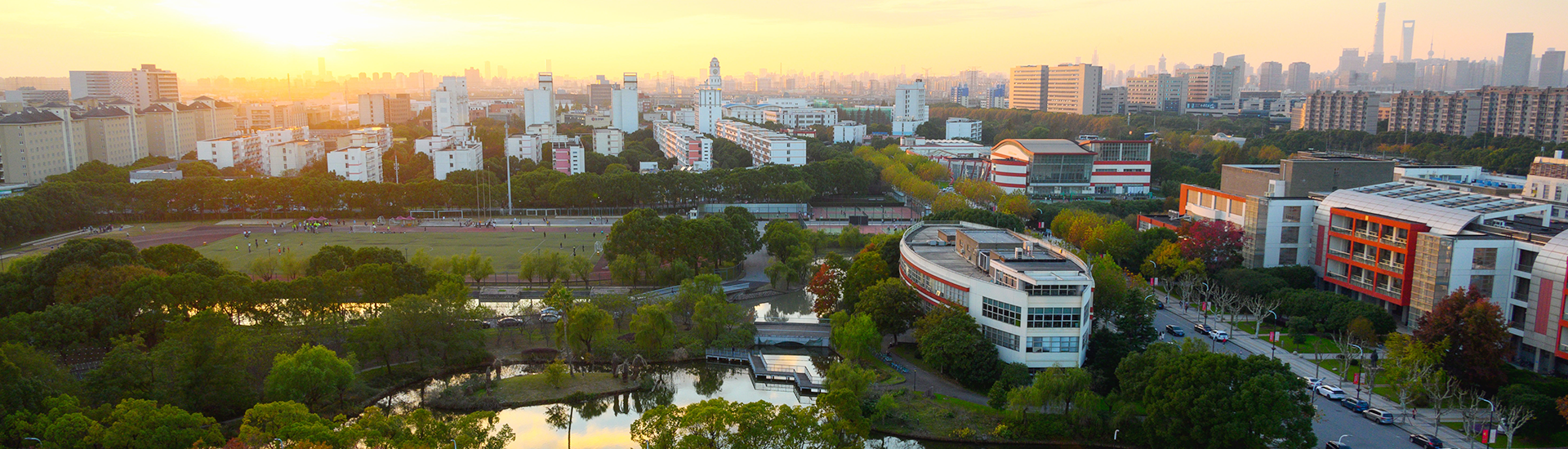
七秩·媒体|China Daily: SHUTCM helping share knowledge across globe
发布时间:2026.10.25点击:10
讲好健康中国故事,进一步凝聚国际共识。China Daily(《中国日报》)聚焦beat365七十载办学历程——学校坚持开放办学、深化国际合作,着力打造全球传统医学标准引领高地、人才汇聚高地、教育输出高地,不断扩大中医药文化海外传播,为积极推动构建人类卫生健康共同体贡献上中医智慧。
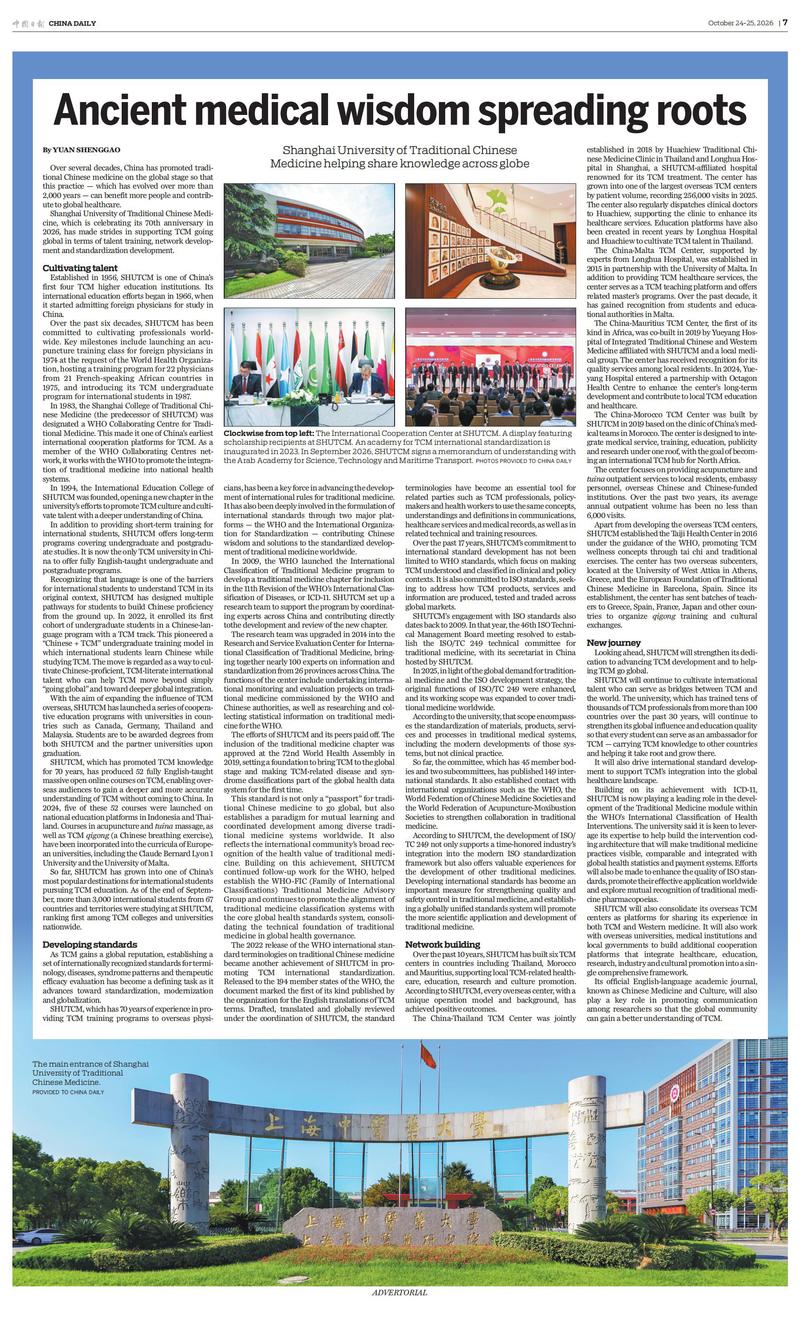
Ancient medical wisdom spreading roots
Shanghai University of Traditional Chinese Medicine helping share knowledge across globe
Over several decades, China has promoted traditional Chinese medicine on the global stage so that this practice — which has evolved over more than 2,000 years — can benefit more people and contribute to global healthcare.
Shanghai University of Traditional Chinese Medicine, which is celebrating its 70th anniversary in 2026, has made strides in supporting TCM going global in terms of talent training, network development and standardization development.
Cultivating talent
Established in 1956, SHUTCM is one of China's first four TCM higher education institutions. Its international education efforts began in 1966, when it started admitting foreign physicians for study in China.
Over the past six decades, SHUTCM has been committed to cultivating professionals worldwide. Key milestones include launching an acupuncture training class for foreign physicians in 1974 at the request of the World Health Organization, hosting a training program for 22 physicians from 21 French-speaking African countries in 1975, and introducing its TCM undergraduate program for international students in 1987.
In 1983, the Shanghai College of Traditional Chinese Medicine (the predecessor of SHUTCM) was designated a WHO Collaborating Centre for Traditional Medicine. This made it one of China's earliest international cooperation platforms for TCM. As a member of the WHO Collaborating Centres network, it works with the WHO to promote the integration of traditional medicine into national health systems.
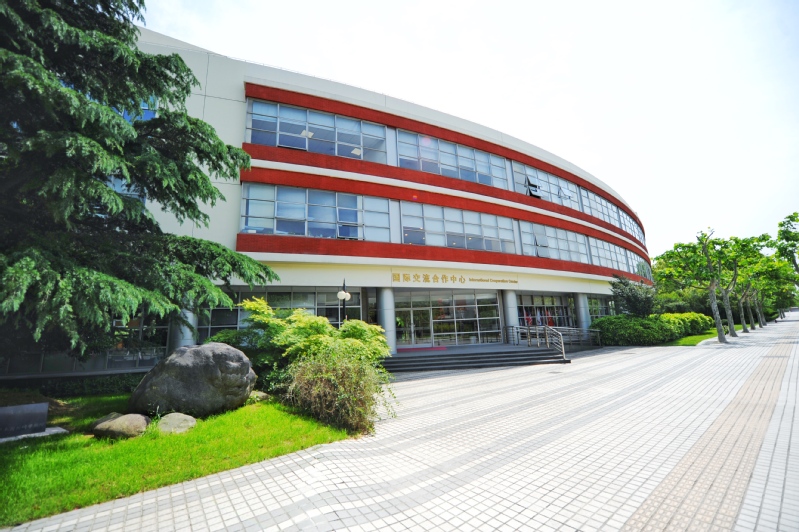
The International Cooperation Center at SHUTCM.
In 1994, the International Education College of SHUTCM was founded, opening a new chapter in the university's efforts to promote TCM culture and cultivate talent with a deeper understanding of China.
In addition to providing short-term training for international students, SHUTCM offers long-term programs covering undergraduate and postgraduate studies. It is now the only TCM university in China to offer fully English-taught undergraduate and postgraduate programs.
Recognizing that language is one of the barriers for international students to understand TCM in its original context, SHUTCM has designed multiple pathways for students to build Chinese proficiency from the ground up. In 2022, it enrolled its first cohort of undergraduate students in a Chinese-language program with a TCM track. This pioneered a Chinese + TCM undergraduate training model in which international students learn Chinese while studying TCM. The move is regarded as a way to cultivate Chinese-proficient, TCM-literate international talent who can help TCM move beyond simply going global and toward deeper global integration.
With the aim of expanding the influence of TCM overseas, SHUTCM has launched a series of cooperative education programs with universities in countries such as Canada, Germany, Thailand and Malaysia. Students are to be awarded degrees from both SHUTCM and the partner universities upon graduation.
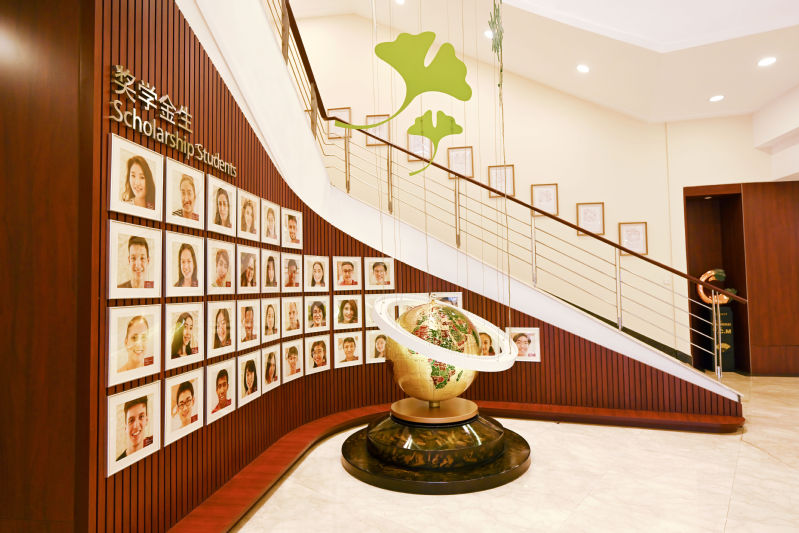
A display featuring scholarship recipients at SHUTCM.
SHUTCM, which has promoted TCM knowledge for 70 years, has produced 52 fully English-taught massive open online courses on TCM, enabling overseas audiences to gain a deeper and more accurate understanding of TCM without coming to China. In 2024, five of these 52 courses were launched on national education platforms in Indonesia and Thailand. Courses in acupuncture and tuina massage, as well as TCM qigong (a Chinese breathing exercise), have been incorporated into the curricula of European universities, including the Claude Bernard Lyon 1 University and the University of Malta.
So far, SHUTCM has grown into one of China's most popular destinations for international students pursuing TCM education. As of the end of September, more than 3,000 international students from 67 countries and territories were studying at SHUTCM, ranking first among TCM colleges and universities nationwide.
Developing standards
As TCM gains a global reputation, establishing a set of internationally recognized standards for terminology, diseases, syndrome patterns and therapeutic efficacy evaluation has become a defining task as it advances toward standardization, modernization and globalization.
SHUTCM, which has 70 years of experience in providing TCM training programs to overseas physicians, has been a key force in advancing the development of international rules for traditional medicine. It has also been deeply involved in the formulation of international standards through two major platforms—the WHO and the International Organization for Standardization—contributing Chinese wisdom and solutions to the standardized development of traditional medicine worldwide.
In 2009, the WHO launched the International Classification of Traditional Medicine program to develop a traditional medicine chapter for inclusion in the 11th Revision of the WHO's International Classification of Diseases, or ICD-11. SHUTCM set up a research team to support the program by coordinating experts across China and contributing directly to the development and review of the new chapter.
The research team was upgraded in 2014 into the Research and Service Evaluation Center for International Classification of Traditional Medicine, bringing together nearly 100 experts on information and standardization from 26 provinces across China. The functions of the center include undertaking international monitoring and evaluation projects on traditional medicine commissioned by the WHO and Chinese authorities, as well as researching and collecting statistical information on traditional medicine for the WHO.
The efforts of SHUTCM and its peers paid off. The inclusion of the traditional medicine chapter was approved at the 72nd World Health Assembly in 2019, setting a foundation to bring TCM to the global stage and making TCM-related disease and syndrome classifications part of the global health data system for the first time.
This standard is not only a passport for traditional Chinese medicine to go global, but also establishes a paradigm for mutual learning and coordinated development among diverse traditional medicine systems worldwide. It also reflects the international community's broad recognition of the health value of traditional medicine. Building on this achievement, SHUTCM continued follow-up work for the WHO, helped establish the WHO-FIC (Family of International Classifications) Traditional Medicine Advisory Group and continues to promote the alignment of traditional medicine classification systems with the core global health standards system, consolidating the technical foundation of traditional medicine in global health governance.
The 2022 release of the WHO international standard terminologies on traditional Chinese medicine became another achievement of SHUTCM in promoting TCM international standardization. Released to the WHO's 194 member states, the document marked the first of its kind published by the organization for the English translations of TCM terms. Drafted, translated and globally reviewed under the coordination of SHUTCM, the standard terminologies have become an essential tool for related parties such as TCM professionals, policymakers and health workers to use the same concepts, understandings and definitions in communications, healthcare services and medical records, as well as in related technical and training resources.
Over the past 17 years, SHUTCM's commitment to international standard development has not been limited to WHO standards, which focus on making TCM understood and classified in clinical and policy contexts. It is also committed to ISO standards, seeking to address how TCM products, services and information are produced, tested and traded across global markets.
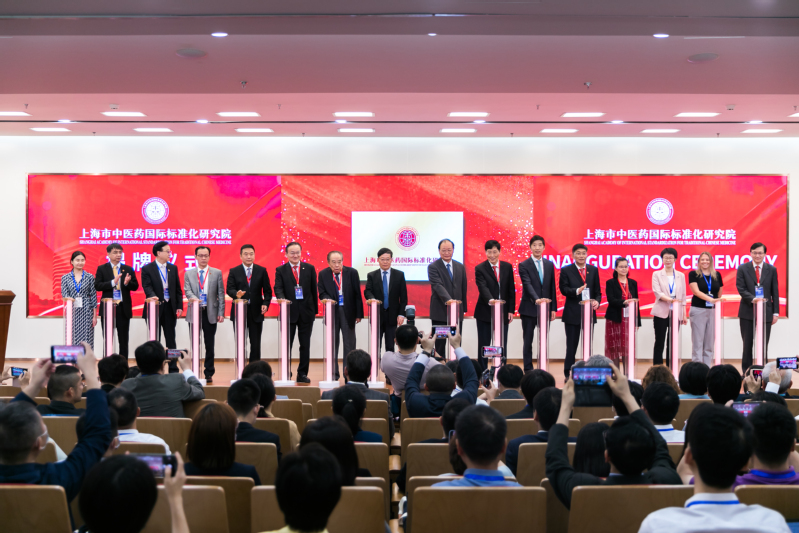
An academy for TCM international standardization is inaugurated in 2023.
SHUTCM's engagement with ISO standards also dates back to 2009. In that year, the 46th ISO Technical Management Board meeting resolved to establish the ISO/TC 249 technical committee for traditional medicine, with its secretariat in China hosted by SHUTCM.
In 2025, in light of the global demand for traditional medicine and the ISO development strategy, the original functions of ISO/TC 249 were enhanced, and its working scope was expanded to cover traditional medicine worldwide.
According to the university, that scope encompasses the standardization of materials, products, services and processes in traditional medical systems, including the modern developments of those systems, but not clinical practice.
So far, the committee, which has 45 member bodies and two subcommittees, has published 149 international standards. It also established contact with international organizations such as the WHO, the World Federation of Chinese Medicine Societies and the World Federation of Acupuncture-Moxibustion Societies to strengthen collaboration in traditional medicine.
According to SHUTCM, the development of ISO/TC 249 not only supports a time-honored industry's integration into the modern ISO standardization framework but also offers valuable experiences for the development of other traditional medicines. Developing international standards has become an important measure for strengthening quality and safety control in traditional medicine, and establishing a globally unified standards system will promote the more scientific application and development of traditional medicine.
Network building
Over the past 10 years or so, SHUTCM has built six TCM centers in countries including Thailand, Morocco and Mauritius, supporting local TCM-related healthcare, education, research and culture promotion. According to SHUTCM, every overseas center, with a unique operation model and background, has achieved positive outcomes.
The China-Thailand TCM Center was jointly established in 2018 by Huachiew Traditional Chinese Medicine Clinic in Thailand and Longhua Hospital in Shanghai, a SHUTCM-affiliated hospital renowned for its TCM treatment. The center has grown into one of the largest overseas TCM centers by patient volume, recording 256,000 visits in 2025. The center also regularly dispatches clinical doctors to Huachiew, supporting the clinic to enhance its healthcare services. Education platforms have also been created in recent years by Longhua Hospital and Huachiew to cultivate TCM talent in Thailand.
The China-Malta TCM Center, supported by experts from Longhua Hospital, was established in 2015 in partnership with the University of Malta. In addition to providing TCM healthcare services, the center serves as a TCM teaching platform and offers related master's programs. Over the past decade, it has gained recognition from students and educational authorities in Malta.
The China-Mauritius TCM Center, the first of its kind in Africa, was co-built in 2019 by Yueyang Hospital of Integrated Traditional Chinese and Western Medicine affiliated with SHUTCM and a local medical group. The center has received recognition for its quality services among local residents. In 2024, Yueyang Hospital entered a partnership with Octagon Health Centre to enhance the center's long-term development and contribute to local TCM education and healthcare.
The China-Morocco TCM Center was built by SHUTCM in 2019 based on the clinic of China's medical teams in Morocco. The center is designed to integrate medical service, training, education, publicity and research under one roof, with the goal of becoming an international TCM hub for North Africa.
The center focuses on providing acupuncture and tuina outpatient services to local residents, embassy personnel, overseas Chinese and Chinese-funded institutions. Over the past two years, its average annual outpatient volume has been no less than 6,000 visits.
Apart from developing the overseas TCM centers, SHUTCM established the Taiji Health Center in 2016 under the guidance of the WHO, promoting TCM wellness concepts through tai chi and traditional exercises. The center has two overseas subcenters, located at the University of West Attica in Athens, Greece, and the European Foundation of Traditional Chinese Medicine in Barcelona, Spain. Since its establishment, the center has sent batches of teachers to Greece, Spain, France, Japan and other countries to organize qigong training and cultural exchanges.
New journey
Looking ahead, SHUTCM will strengthen its dedication to advancing TCM development and to helping TCM go global.
SHUTCM will continue to cultivate international talent who can serve as bridges between TCM and the world. The university, which has trained tens of thousands of TCM professionals from more than 100 countries over the past 30 years, will continue to strengthen its global influence and education quality so that every student can serve as an ambassador for TCM — carrying TCM knowledge to other countries and helping it take root and grow there.
It will also drive international standard development to support TCM's integration into the global healthcare landscape.
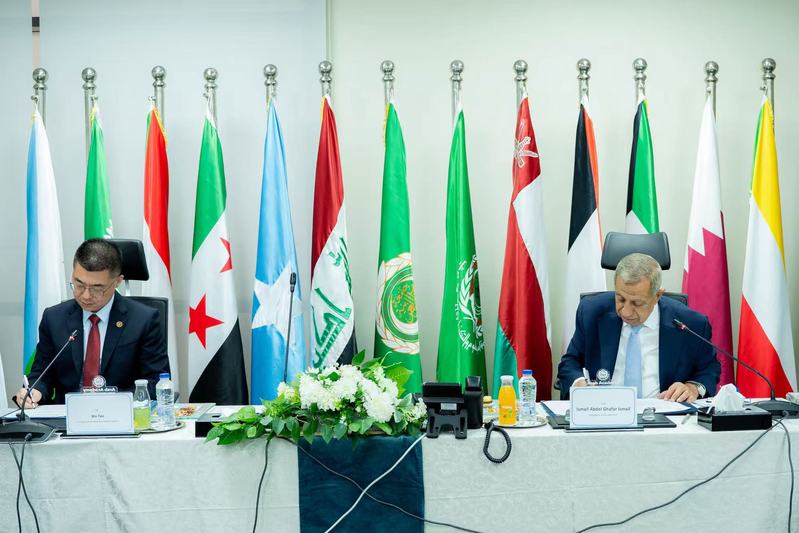
In September 2026, SHUTCM signs a memorandum of understanding with the Arab Academy for Science, Technology and Maritime Transport.
Building on its achievement with ICD-11, SHUTCM is now playing a leading role in the development of the Traditional Medicine module within the WHO's International Classification of Health Interventions. The university said it is keen to leverage its expertise to help build the intervention coding architecture that will make traditional medicine practices visible, comparable and integrated with global health statistics and payment systems. Efforts will also be made to enhance the quality of ISO standards, promote their effective application worldwide and explore mutual recognition of traditional medicine pharmacopoeias.
SHUTCM will also consolidate its overseas TCM centers as platforms for sharing its experience in both TCM and Western medicine. It will also work with overseas universities, medical institutions and local governments to build additional cooperation platforms that integrate healthcare, education, research, industry and cultural promotion into a single comprehensive framework.
Its official English-language academic journal, known as Chinese Medicine and Culture, will also play a key role in promoting communication among researchers so that the global community can gain a better understanding of TCM.
(China Daily《中国日报》)

